
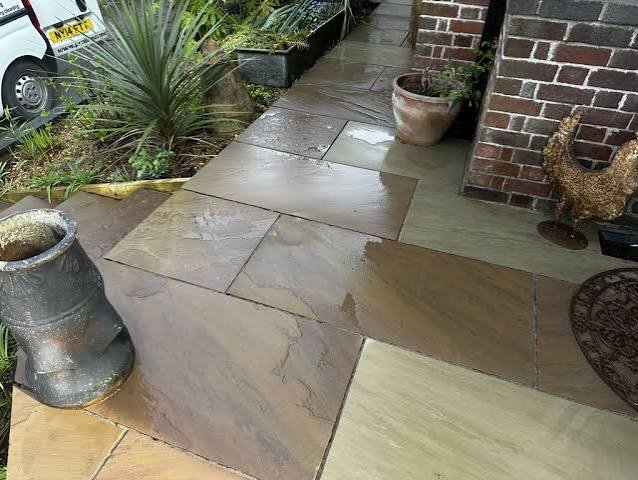
Patios collect a complicated mixture of algae, moss, soil, leaf tannins, food spills and weather staining. Because paving materials vary so widely, the best cleaning method depends on the surface, its age, the condition of the joints and the type of contamination.
A powerful pressure washer can make an immediate visual difference, but power alone is not the same as a good result. Careful preparation, suitable treatments and tidy rinse-down are what protect the paving and the garden around it.
Identify your paving before cleaning
Indian sandstone
Sandstone is popular because of its natural colour variation and textured finish. It can usually be cleaned successfully, but very aggressive pressure may expose softer layers or mark weathered slabs. Acidic products can also react unpredictably with some stone.
Limestone
Limestone is more chemically sensitive than many homeowners realise. Acid-based cleaners can etch the surface and change its appearance. Product selection should be conservative and tested first.
Porcelain
Porcelain itself is dense and relatively resistant, although textured finishes still trap dirt. The vulnerable areas are often the grout, jointing compound and surrounding silicone or render rather than the tile.
Concrete flags and block paving
These are generally robust but may be faded, coated or weathered. Block-paved patio areas usually need re-sanding after a deep clean, just like a driveway.
What are patio black spots?
The stubborn dark dots commonly seen on sandstone and concrete are often colonies of lichen. They attach tightly to the surface and are rarely removed by a quick wash alone. A staged treatment is usually needed, with realistic expectations where growth has been present for years.
Simply increasing pressure can scar the paving while leaving the deeper growth behind. A suitable treatment given enough dwell time is generally more effective and less aggressive.
A professional patio-cleaning process
- Survey the area: identify paving, pointing defects, drainage routes, delicate planting and adjoining walls.
- Clear and protect: remove furniture and pots, sweep debris and protect vulnerable items.
- Apply appropriate treatment: target algae, lichen or staining where required.
- Clean evenly: use controlled pressure and consistent passes to avoid stripes.
- Detail edges: clean around steps, drainage channels and thresholds carefully.
- Rinse thoroughly: leave walls, glass and planting beds tidy.
- Complete aftercare: replace lost jointing material where appropriate and advise on drying or sealing.
Our patio cleaning service explains the approach used on local properties.
Protecting pointing and joints
Old sand-and-cement pointing may already be loose before cleaning. Pressure washing can reveal that weakness. Modern resin jointing compounds also vary: some tolerate cleaning well, while poorly installed or degraded joints can lift.
A reputable cleaner should point out visible defects before work begins. Cleaning cannot repair failed pointing, but planning the nozzle angle and pressure can avoid unnecessary loss.
Can a patio be sealed?
Many patios can be sealed, but the product must match the paving and the desired finish. Some sealers enhance colour, some remain nearly invisible, and others are designed mainly to reduce absorption. Moisture trapped below a coating can cause cloudiness or patchiness, so drying conditions are crucial.
Porcelain often needs little or no sealing, while porous natural stone may benefit in certain situations. It should always be an informed choice rather than an automatic add-on.
DIY patio maintenance between professional cleans
- Sweep leaves and soil regularly so they do not hold moisture.
- Move planters occasionally to prevent permanent damp rings.
- Keep drainage channels clear.
- Treat small areas of organic growth early with a surface-compatible product.
- Avoid repeated close-range blasting with a domestic pressure washer.
Patio cleaning FAQs
Can all black spot be removed?
Many areas improve dramatically, but deeply established lichen can require repeat treatment and complete removal is not always possible without risking surface damage.
Will plants be safe?
Plants should be assessed, moved or protected where possible, and surrounding areas rinsed carefully. No contractor should be careless with chemical runoff.
When is the best time to clean a patio?
Cleaning can be carried out through much of the year, although dry, mild conditions make drying and any follow-on jointing or sealing easier.
Will cleaning remove efflorescence?
White mineral deposits are different from ordinary dirt and may need specialist treatment. Standard pressure washing alone may not solve them.
Get a method matched to the paving
The safest question is not “How powerful is the machine?” but “What is this paving, and what does it need?” Read our driveway cleaning guide for block paving and resin surfaces, or our render cleaning guide for adjoining walls.
For a tailored quotation, send photographs and your postcode through our contact page.